In the annals of military history, the rumble of engines has often preceded the thunder of war. From the Harley-Davidsons of World War II to the rugged Jeeps of desert campaigns, the internal combustion engine has been the soundtrack of conflict. Yet, as geopolitical tensions escalate once again in the Persian Gulf, a profound and silent shift is taking place—not just on the battlefields of tomorrow, but on the recreational trails that crisscross our planet.
Welcome to the era of the electric motocross bike. It is a revolution defined not by noise, but by its absence; not by smoke, but by stealth. As the United States and Iran edge toward the brink of a potential ground conflict in early 2026, the strategic advantages of electric off-road vehicles (EVs) are becoming impossible to ignore . Simultaneously, the consumer market is witnessing a surge in high-performance electric dirt bikes, led by innovators like Edgemoto, which are proving that sustainability and adrenaline are no longer mutually exclusive.
This article explores the convergence of these two worlds—the silent revolution of electric motocross and its profound implications for both modern warfare and the future of off-road recreation.
1. The Geopolitical Catalyst: Why Silence is Golden
To understand the rise of the electric motocross bike, one must first understand the changing nature of conflict. In early 2026, satellite imagery revealed a significant buildup of U.S. military assets in the Middle East. Patriot missile systems were mounted on mobile truck launchers at Qatar’s Al Udeid Air Base, while fighter jets and reconnaissance aircraft deployed to strategic locations across the region . Analysts suggest that the U.S. is preparing for a potential large-scale ground operation, with estimates suggesting a requirement of up to 40,000 to 400,000 troops depending on the scale of engagement .
In such high-stakes environments, the element of surprise is paramount. This is where the internal combustion engine—a staple of military logistics for over a century—reveals its greatest weakness: it is loud, hot, and logistically demanding.
The Acoustic Signature Problem
A conventional 450cc motocross bike produces sound levels around 96 dB, akin to a chainsaw or a jackhammer . In a combat scenario, this noise travels miles, alerting adversaries to movement, betraying ambush positions, and compromising reconnaissance missions. Conversely, electric motocross bikes operate at approximately 65 dB—quieter than a vacuum cleaner or a normal conversation .
The Thermal Signature Advantage
Beyond acoustics, electric motors emit significantly lower thermal signatures compared to gas engines. In desert warfare, where thermal imaging is a primary surveillance tool, a rider on a silent electric bike becomes a ghost on the battlefield, far harder to detect than a rider on a heat-radiating, fuel-burning machine .
2. The Military Adoption: From Trials to Front Lines
The strategic advantages of electric two-wheelers are not lost on defense ministries worldwide. While the U.S. Department of Defense has historically shown a “love/hate relationship” with motorcycles, the electric revolution is forcing a reassessment .
Recent years have seen a flurry of activity in this sector. The British Army has tested high-powered electric bikes capable of 50 mph, utilizing direct-drive setups with no chains or gears to maximize silence . France has also explored electric dirt bikes for rapid deployment, learning lessons from the battlefields of Ukraine, where small, agile, and quiet vehicles have proven essential for special forces operations .
The Slovenian company STRiX has developed an all-electric dirt bike specifically designed for military use. With 70 kW (95 hp) and a staggering 1,050 Nm of torque at the rear wheel, this machine is no mere toy. It is designed to be transported on JLTVs (Joint Light Tactical Vehicles) and used for “short, intense ‘in-and-out’ missions” . It features a 6.3 kWh battery that can recharge from 20% to 80% in just ten minutes, addressing one of the primary criticisms of electric vehicles in combat: range anxiety .
Logistics and the “Mothership” Concept
In the military context, electric motocross bikes excel when used in conjunction with a “mothership”—a larger vehicle or base where they can recharge. They allow special forces to cover the “last part approach” silently, moving swiftly and stealthily toward a target . Furthermore, they reduce the logistical tail. A gallon of gasoline requires a supply chain vulnerable to attack; electricity can be generated by portable solar panels or drawn from a standard wall outlet, a capability that even the U.S. Air National Guard is exploring for base patrols .
3. The Technological Surge: Edgemoto and the New Breed
While military applications drive innovation in durability and stealth, the consumer market is propelling advancements in power, range, and affordability. At the forefront of this consumer revolution is Edgemoto, a company that embodies the shift from niche eco-friendly alternatives to legitimate performance powerhouses.
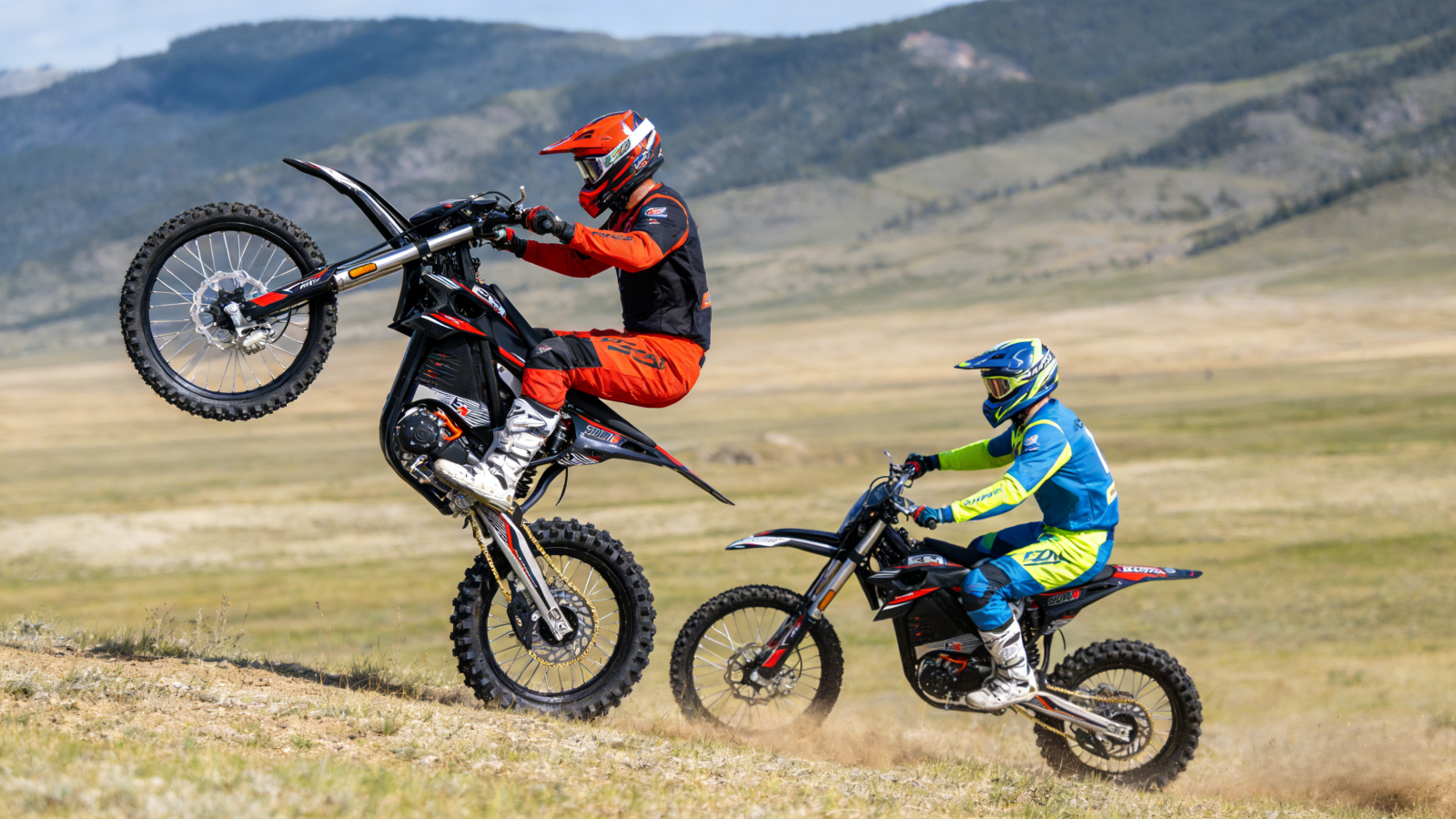
Edgemoto’s lineup, particularly the EM3000 and EM5000 models, demonstrates how far the technology has come. These are not “e-bikes” in the pedal-assist sense; they are full-sized, adult off-road motorcycles that challenge the supremacy of gas-powered 450cc machines .
Performance Metrics that Matter
For years, the knock against electric motocross was that it lacked the “grunt” of gas bikes. That argument is now obsolete.
| Metric | Edgemoto EM5000 (Electric) | Typical 450cc Gas Bike |
|---|---|---|
| Peak Power | 25 kW (25,000 watts) | Approx. 45 hp (33 kW) |
| Wheel Torque | 1,200 Nm (instant) | 180 Nm (peaks at high RPM) |
| Powertrain | Mid-drive brushless DC | 4-stroke single cylinder |
| Maintenance | ~10 moving parts | 200+ moving parts |
| Noise Level | ~65 dB | ~96 dB |
Data sourced from Edgemoto specifications and industry standards .
The defining characteristic of these electric motors is instant torque. Unlike a gas engine, which must rev up to reach its power band, an electric motor delivers 100% of its torque from 0 RPM. For a motocross rider, this means explosive acceleration out of corners and the ability to conquer steep, technical hill climbs that would stall a conventional bike.
Engineering for the Earth
Beyond performance, Edgemoto is capitalizing on the environmental imperative. Off-road riding has long been scrutinized for its ecological impact. Gas bikes emit an estimated 1.3 tons of CO2 annually and contribute to soil erosion and noise pollution that disturbs wildlife .
Edgemoto’s approach addresses these criticisms head-on. Their bikes feature zero tailpipe emissions, and their design incorporates sustainable practices, such as using 75% recycled aluminum in the frame and 30% reclaimed rubber in the tires . This “circular design” philosophy is crucial for maintaining access to trails that are increasingly closed to traditional dirt bikes due to noise and emissions regulations.
4. The Market Momentum: A 15% CAGR and the 2026 Inflection Point
The transition from internal combustion to electric in the off-road sector is not a distant prediction; it is happening now. According to Persistence Market Research, the global dirt bike market is projected to grow from $9.6 billion in 2026 to $14.8 billion by 2033 .
The most striking statistic, however, is the projected growth rate for electric dirt bikes. While 4-stroke ICE models still dominate the market (accounting for roughly 60% of revenue), electric models are the fastest-growing powertrain segment, expected to expand at a compound annual growth rate (CAGR) of approximately 15% through 2033 .
Key Drivers of Growth
- Regulatory Pressure: Governments worldwide are tightening emissions and noise standards. The European Union’s Stage V regulations and California’s CARB rules are making it increasingly difficult and expensive to sell new gas-powered off-road vehicles .
- Declining Battery Costs: The cost of lithium-ion battery packs per kilowatt-hour has declined dramatically over the past decade, making electric powertrains more affordable .
- New Market Entrants: Major manufacturers are finally committing. At the EICMA 2025 show, Yamaha unveiled the YE-01 Racing Concept, developed in partnership with Electric Motion SAS. It is designed to compete in the new MXEP electric motocross series, signaling that the sport’s top tier is embracing electrification .
As Yamaha’s entry suggests, the future of the sport is electric. When manufacturers like Yamaha—with decades of experience in motocross racing—invest heavily in electric prototypes, it validates the technology for the mass market.
5. The Human Factor: Rediscovering the Trail
For all the talk of torque, torque, and military strategy, the true heart of the electric revolution lies in the experience of the rider. There is a romantic notion in motocross that the noise is part of the soul of the sport. However, riders who have switched to electric paint a different picture.
They speak of “hearing the trail”—the crunch of gravel under the tires, the rustle of leaves, and the sound of their own breathing . This sensory shift creates a more immersive, almost meditative connection with the environment.
Professional riders like Jake “The Surgeon” Thompson, a three-time MX champion who switched to an Edgemoto in 2024, have noted that the bikes offer a competitive advantage. “I thought electric would feel sterile,” Thompson said. “Instead, it’s like the bike reads my mind. And I can finally talk to my mechanic without yelling” .
For beginners, electric bikes are less intimidating. The adjustable power modes allow novices to learn throttle control without the fear of whiskey throttle (unintended acceleration), while the lack of a clutch and gearbox simplifies the learning curve .
6. The Road Ahead: From Self-Charging Trails to AI Co-Pilots
As we look beyond 2026, the convergence of military need and consumer demand will only accelerate innovation. The future of electric motocross is not just about replacing gas tanks with batteries; it is about redefining what a motorcycle can be.
- Self-Charging Trails: Prototypes are underway for courses embedded with induction coils that could charge bikes wirelessly as they ride .
- AI Integration: Onboard systems are being developed that act as “AI co-pilots,” analyzing riding style in real-time and suggesting suspension adjustments or racing lines to improve lap times .
- Digital Performance Ecosystems: As seen in the automotive industry, connected motorcycles will offer subscription-based performance analytics, battery health monitoring, and over-the-air firmware updates .
- Advanced Charging: Military-grade bikes like the STRiX are already demonstrating ultra-fast DC charging capabilities (20%-80% in 10 minutes), a feature that will soon trickle down to consumer models .
Conclusion: The Quiet Dawn
The roar of the internal combustion engine has dominated off-road culture for over a century. It has been a symbol of freedom, rebellion, and raw power. But as we navigate the complexities of the 2020s—from escalating geopolitical conflicts to the pressing need for environmental stewardship—the definition of power is changing.
In the deserts of the Middle East, where the threat of war looms, the ability to move silently and stealthily is a strategic imperative . On the trails of California and the forests of Europe, the ability to ride without disturbing wildlife or violating noise ordinances is the key to preserving the sport for future generations .
Companies like Edgemoto are proving that electric motocross bikes are not a compromise. With models like the EM5000 delivering 25kW of peak power and 1,200 Nm of torque, they offer a performance experience that is not just equal to, but in many ways superior to, their gas-powered ancestors .
The silent revolution is here. It is powered by lithium, driven by software, and embraced by a new generation of riders who refuse to choose between their love for the planet and their need for speed. As the sun sets on the age of fossil fuels, a new dawn rises over the off-road world—one that is quieter, cleaner, and perhaps, more thrilling than ever before.