Unplugged: Finding Freedom on an Electric Motocross Bike
In the pantheon of motorsport, few experiences rival the raw, visceral intensity of motocross. The scent of premixed fuel hanging in the morning air, the cacophony of 450cc four-stroke engines ripping through the silence of a forest, and the delicate, life-or-death dance of clutch, throttle, and brake have defined the sport for over a century. Yet, as the internal combustion engine faces its most significant existential challenge in the automotive sector, a parallel—and arguably more profound—revolution is taking place in the dirt. We are witnessing the dawn of the electric off-road era. Against the backdrop of the global electric vehicle (EV) boom, the rise of Electric Motocross Bikes is not merely a trend; it is a fundamental redefinition of what it means to ride off-road.
As companies like Edgemoto push the boundaries of battery and chassis technology, we are beginning to understand that the transition from gasoline to electricity in the dirt is not about sacrificing soul for sustainability. Instead, it is about finding a new kind of freedom—one defined by instant torque, unprecedented access, and a harmonious connection with the terrain that was previously drowned out by noise.
The Silent Shockwave: Context from the Automotive World
To understand the seismic shift happening in off-road motorcycling, one must first look at the four-wheeled world. The automotive industry’s transition to electric vehicles has served as a massive, global-scale research and development laboratory. Over the last decade, billions of dollars have been poured into lithium-ion battery chemistry, thermal management systems, and compact, high-output electric motors.
This automotive boom has created a trickle-down effect that the motorcycle industry is only now beginning to fully leverage. When Tesla began proving that electric powertrains could outperform internal combustion engines in acceleration and range, it shattered the public perception of EVs as “golf carts.” When Ford and GM began electrifying their truck lineups, they validated that electric propulsion could handle towing, payload, and the brutal durability demands of heavy-duty work.
For off-road motorcycles, this technological validation is critical. A motocross bike is subjected to harsher conditions than almost any other land vehicle. It is repeatedly launched 80 feet through the air, slammed into hardpack dirt, submerged in mud, and shaken by vibrations that would disintegrate standard automotive components. The EV boom provided the supply chain and the confidence needed to develop batteries that can survive these extremes and motors that can deliver the brutal, instantaneous power required to clear a triple jump.
The Physics of Fun: Why Electric Works Off-Road
The argument for electric motocross bikes often begins with environmentalism—zero tailpipe emissions, reduced noise pollution, and the ability to ride in areas previously closed due to sound restrictions. While these are significant advantages, they are merely the byproducts of a deeper engineering truth: electric motors are inherently superior to internal combustion engines for off-road performance.
In a traditional gasoline-powered dirt bike, power is a narrow, peaky commodity. A 250cc four-stroke might produce 40 horsepower, but only between 12,000 and 14,000 revolutions per minute (RPM). To keep the engine in this “powerband,” the rider must master the clutch, constantly shifting gears to balance traction with momentum. It is a skill that takes years to develop. An electric motor, by contrast, delivers instantaneous peak torque from zero RPM. There is no lag, no clutch modulation required to get the bike moving, and no stalling.
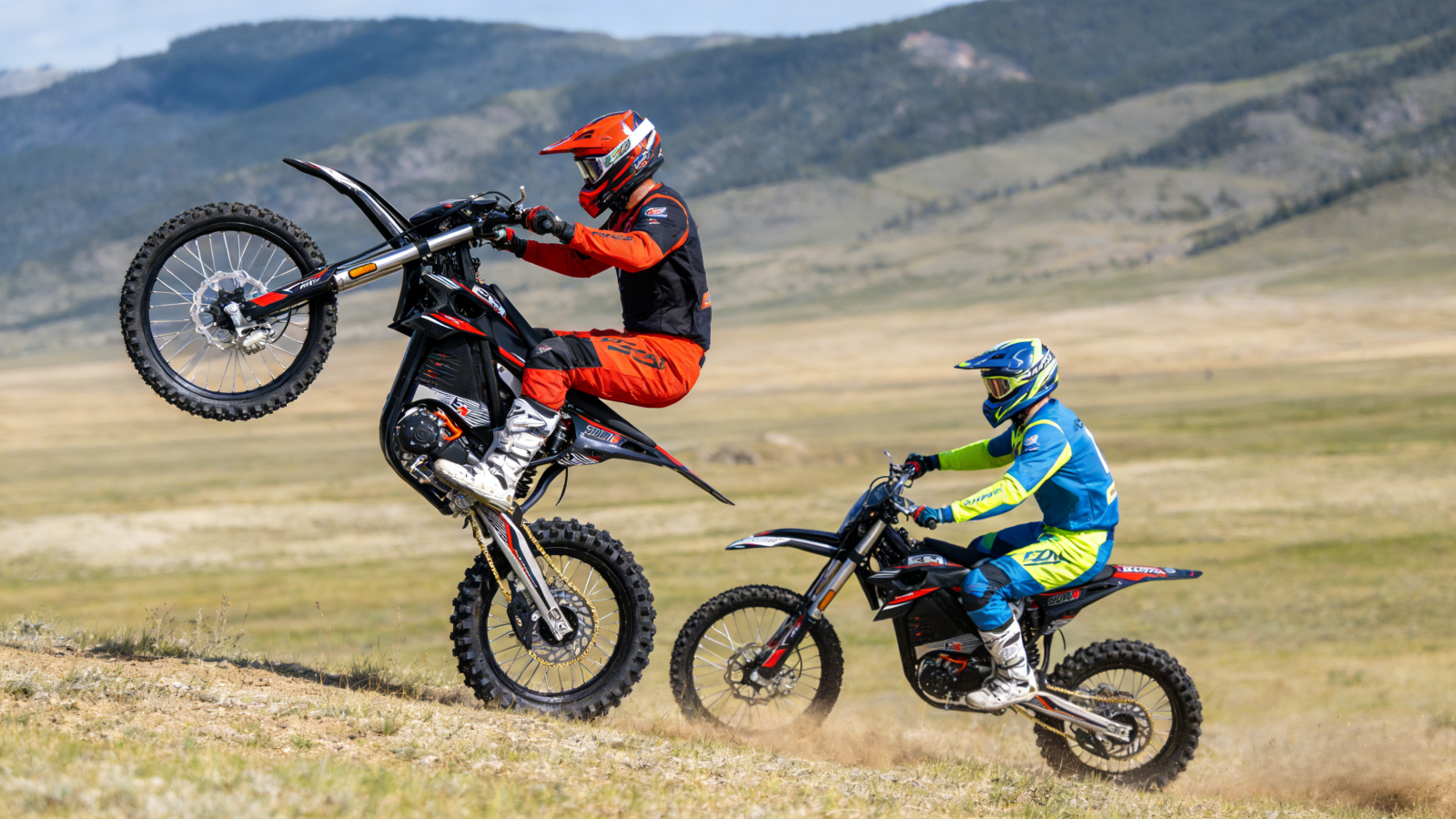
This changes the riding dynamic entirely. For a beginner, an electric bike lowers the barrier to entry dramatically. There is no fear of stalling on a steep hill climb; the rider simply twists the throttle and the bike surges forward with linear, predictable power. For an expert, this torque delivery allows for a new style of riding—one where traction is controlled not by the friction zone of a clutch, but by the precise millimeter of throttle rotation. This allows riders to approach obstacles with a level of surgical precision that is physically impossible on a gas bike.
Furthermore, the absence of a gearbox and clutch does more than just simplify the ride; it allows for a complete re-engineering of the chassis. Without the need to accommodate a tall, hot engine block, an airbox, and a gearbox, engineers are free to centralize mass. Most modern electric off-road bikes place the motor low and central, with the battery pack acting as a stressed member of the frame. This results in a moment of inertia that is drastically lower than a gas bike. In layman’s terms, the bike feels lighter, turns more effortlessly, and flicks from side to side in the air with less effort than its gasoline counterpart, even if the overall weight figure is similar.
Edgemoto and the New Wave of Off-Road Innovation
As the market matures, a new generation of manufacturers is emerging to challenge the status quo. While legacy brands like KTM (with its Freeride and SX-E series) and Stark Future (with the VARG) have made headlines, companies like Edgemoto are defining the next tier of accessibility and performance. Edgemoto represents the democratization of the electric off-road experience. By focusing on robust engineering, swappable battery architectures, and user-friendly power delivery, brands like Edgemoto are proving that electric motocross is not just for the deep-pocketed early adopter, but for the everyday rider who wants to ride more often with less maintenance.
One of the critical innovations that Edgemoto and its contemporaries bring to the table is the modular battery system. Range anxiety is the Achilles’ heel of electric vehicles, but in off-road motorcycling, it manifests differently than in cars. A motocross rider might only ride for 15 to 20 minutes in a high-intensity session before needing a break. With swappable batteries, a rider can simply unclip a depleted unit, click in a fresh one, and be back on the track in under a minute. This eliminates the long downtime associated with charging and aligns perfectly with the natural rhythm of track riding or trail riding with friends.
Moreover, the maintenance paradigm is shifting. Ask any weekend warrior what they dread most, and they will likely say “valve adjustments” or “oil changes.” A gasoline dirt bike requires intensive maintenance schedules; engines are often rebuilt after 50 to 100 hours of racing. Electric motocross bikes, by contrast, have a fraction of the moving parts. There is no oil to change, no air filter to clean, no valves to shim. The maintenance shifts from mechanical engine work to drivetrain cleaning and battery care. This lowers the total cost of ownership significantly and allows riders to spend more time riding and less time wrenching—a value proposition that is especially appealing as the sport looks to attract new participants.
The “Unplugged” Experience: Redefining Freedom
The title of this exploration, Unplugged, is deliberately paradoxical. To ride an electric motorcycle, one is, by definition, “plugged in” to the grid. However, the freedom experienced while riding one is an unplugging from the constraints of traditional motorsport.
Consider the issue of access. Across the United States and Europe, off-road riding areas are shrinking. The primary complaint from non-riders and land management agencies is noise. A group of four-stroke dirt bikes can be heard from miles away, fracturing the tranquility of natural spaces. Electric motocross bikes are whisper-quiet. At idle, they emit a soft whir; at speed, the sound of the tires tearing through loam and the chain gliding over the sprocket become the dominant noises. This opens the door to “stealth” riding and, more importantly, to negotiations with local governments to allow electric bikes on trails that have been closed to motorized vehicles for decades.
Furthermore, there is the sensory experience. In the world of motorcycling, there has long been a romantic attachment to noise—the “braap” of a two-stroke or the growl of a V-twin. However, after riding an electric bike, many enthusiasts realize that noise is not synonymous with soul. When the engine noise is removed, the rider becomes more attuned to the physics of the ride. You hear the suspension compress over braking bumps. You hear the rear tire clawing for grip on a hard-packed corner. You feel the nuances of the terrain through the handlebars without the vibration of a thumping single-cylinder engine numbing your hands. It is a more meditative, connected experience. It transforms the ride from an assault on the senses into a dialogue with the terrain.
Navigating the Challenges
Despite the compelling advantages, the path to widespread adoption is not without obstacles. For electric motocross bikes to fully supplant gasoline bikes in the mainstream, three key areas require continued evolution: energy density, weight, and infrastructure.
Energy Density: While battery technology has improved exponentially, it still lags behind gasoline in terms of energy stored per pound. A gallon of gasoline contains roughly 33.4 kilowatt-hours of energy. To store that same amount of energy in a lithium-ion battery would weigh hundreds of pounds. Currently, an electric motocross bike can deliver a competitive amount of power, but the duration is limited. For professional motocross racers running 30-minute-plus-two-lap motos, a current electric bike can finish the race, but often with a drop in power towards the end as the battery voltage sags. For trail riders looking to cover 100 miles in a day, current battery capacities require careful planning and support vehicles carrying spare batteries.
Weight: Although the perceived handling of electric bikes is superior due to mass centralization, the actual scale weight is often higher than a top-tier gasoline race bike. A 450cc motocross bike weighs around 220-240 pounds. A premium electric motocross bike often tips the scales at 240-260 pounds. While this extra weight is carried low and feels manageable on the track, it becomes noticeable in slow, technical terrain where the rider has to manhandle the bike over logs or pick it up after a fall. However, with advancements in motor and battery technology, the weight gap is narrowing rapidly year over year.
Infrastructure: For the automotive EV market, the infrastructure challenge is about public charging stations. For off-road motorcycles, it is about logistics. Riders often drive hours to remote trailheads. If they want to ride for a full day, they either need to bring a generator (which reintroduces noise and fossil fuels) or invest in a fleet of expensive spare batteries. Companies like Edgemoto are addressing this by focusing on fast-swap battery ecosystems, making the battery itself a portable, rapidly exchangeable component rather than a permanent part of the chassis.
The Future of Off-Road Riding
Looking forward, the trajectory is clear. The internal combustion engine will not disappear from the dirt overnight; there is too much existing infrastructure, parts availability, and emotional attachment to the sound and feel of gas bikes. However, the momentum is shifting. We are entering a phase where electric motocross bikes are no longer prototypes or niche curiosities—they are production-ready machines capable of matching or exceeding the lap times of their gasoline counterparts.
The involvement of mainstream automotive battery suppliers is accelerating the curve. As the cost of lithium-ion cells continues to fall due to EV mass production, the price parity between gas and electric off-road bikes is approaching. When that parity is reached—combined with the lower maintenance costs—the economic argument for electric will become irrefutable.
Furthermore, the sport itself is evolving. The FIM (Fédération Internationale de Motocyclisme) has already launched the FIM E-Xplorer World Cup, a dedicated electric off-road racing series. This is not just an exhibition; it is a high-stakes development laboratory. Racing improves the breed. As manufacturers push the limits of power delivery, battery cooling, and suspension integration in the crucible of competition, the technology will trickle down to the consumer models offered by brands like Edgemoto and others.
Conclusion
Standing at the trailhead of the future, the electric motocross bike represents more than just a new powertrain option. It represents a philosophical shift in how we interact with the wilderness and with the sport itself. It challenges the definition of “freedom” in off-road riding. For decades, freedom meant the ability to go anywhere, fueled by a jerry can of premix and a loud pipe that announced your presence from miles away.
Today, in the era of climate consciousness and technological convergence, freedom is taking on a new form. It is the freedom to ride without disturbing the wildlife. It is the freedom to step off your back porch without waking the neighbors. It is the freedom to focus purely on technique and the tactile feedback of the earth beneath your wheels, unmediated by vibration and noise.
As automotive giants electrify the streets, the dirt is being quietly revolutionized by specialized innovators like Edgemoto. They are proving that you don’t need a screaming engine to have a thrilling experience. You need torque, you need balance, and you need access. Electric motocross bikes deliver all three in spades. The ride is no longer a performance that disturbs the landscape; it has become a seamless part of it. In the quiet hum of an electric motor climbing a rocky single-track, we are discovering that sometimes, to truly find freedom, you first have to unplug.