
The off-road landscape is undergoing a quiet revolution. Gone are the days when conquering rugged trails required a gas-guzzling, noise-polluting machine that demanded constant maintenance and mechanical expertise. Enter the electric ATV scooter—a hybrid beast that combines the nimble handling of a scooter with the terrain-devouring capabilities of an all-terrain vehicle. Whether you’re looking to explore backcountry trails, manage large properties, or simply inject some adrenaline into your weekend adventures, these electric marvels offer an accessible entry point into off-road recreation.
But with great power comes great responsibility—and a dizzying array of choices. As a beginner, navigating the specifications, features, and marketing claims can feel overwhelming. This comprehensive guide breaks down the seven critical factors you must consider before investing in your first electric ATV scooter, using real-world insights from industry leaders like EdgeMoto to illustrate what separates exceptional machines from expensive mistakes.
1. Motor Power and Configuration: The Heart of Performance
When evaluating electric ATV scooters, motor specifications should be your first stop. Unlike traditional scooters designed for smooth pavement, ATV scooters need substantial grunt to tackle hills, mud, sand, and rocky terrain.
Understanding Wattage Ratings
Electric motors are typically rated by their continuous wattage, with peak power representing short-burst maximums. For adult riders seeking genuine off-road capability, 1,500W per wheel should be considered the baseline. The EdgeMoto I-X5, for instance, features a formidable 4×1,500W brushless hub motor configuration, delivering a combined peak output of 10,000 watts . This quad-motor setup provides the torque necessary to climb steep inclines and power through resistance that would stall lesser machines.
Beginners often make the mistake of comparing total wattage without considering distribution. A single 3,000W motor powering two wheels will struggle where a dual or quad-motor system succeeds, particularly in loose terrain where traction is paramount. Four-wheel-drive configurations, like those found on the I-X5, offer superior grip and stability by delivering power independently to each wheel .
Brushless vs. Brushed Motors
Modern electric ATV scooters universally employ brushless DC (BLDC) motors, and for good reason. These motors offer higher efficiency, greater torque density, and virtually maintenance-free operation compared to their brushed counterparts. The absence of physical brushes means no friction losses, no sparking, and no regular replacement of worn components—crucial considerations for vehicles operated in dusty, dirty environments .
2. Battery Capacity and Chemistry: Your Range Reality Check
Range anxiety isn’t just for Tesla owners. Nothing kills an off-road adventure faster than a depleted battery miles from your starting point. Understanding battery specifications is essential for matching a scooter to your intended use.
Voltage and Amp-Hours Explained
Battery capacity is measured in watt-hours (Wh), calculated by multiplying voltage (V) by amp-hours (Ah). Higher voltage systems (60V–72V) deliver power more efficiently and support faster charging, while amp-hour ratings determine total energy storage. The EdgeMoto I-X5 offers multiple battery configurations: 60V 50Ah, 60Ah, 70Ah, and 80Ah options, providing flexibility based on range requirements and budget constraints .
To put this in perspective, the 60V 50Ah configuration yields 3,000Wh of energy storage, translating to approximately 65 kilometers (40 miles) of real-world range under mixed riding conditions. The 80Ah variant extends this to roughly 80 kilometers (50 miles) . However, these figures assume moderate speeds and terrain. Aggressive throttle use, steep climbs, and soft surfaces like sand or mud can reduce effective range by 30–50%.
Lithium Battery Chemistry
Not all lithium batteries are created equal. The I-X5 utilizes ternary lithium cells (likely NMC—Nickel Manganese Cobalt), which offer an optimal balance of energy density, cycle life, and thermal stability . These cells typically deliver 800–1,000 full charge cycles before capacity degrades to 80%, representing several years of regular use. When evaluating alternatives, avoid cheaper lithium iron phosphate (LFP) batteries that sacrifice energy density for longevity unless your priority is maximum cycle life over range and weight savings.
Charging Infrastructure
Consider your charging setup before purchase. The I-X5 requires 8–10 hours for a full charge using standard chargers . While this is typical for large-capacity batteries, riders with intensive daily use should investigate fast-charging options or spare battery availability. EdgeMoto notes that their batteries carry a 2-year warranty, providing peace of mind against premature degradation .
3. Suspension and Terrain Handling: Comfort Meets Capability
Off-road riding subjects both machine and rider to impacts that would destroy conventional scooters. Robust suspension isn’t a luxury—it’s a necessity for control, safety, and endurance.
Independent Suspension Systems
The gold standard for electric ATV scooters is independent swing-arm suspension on all four wheels. Unlike solid axles that transfer impacts across the entire vehicle, independent systems allow each wheel to react to terrain individually, maintaining tire contact and traction. The EdgeMoto I-X5 features front and rear independent swing arms with progressive damping suspension, adjustable for different rider weights and terrain types .
This adjustability is crucial for beginners. Softer settings provide a plush ride over rocks and roots but may bottom out during aggressive jumps or heavy loads. Firmer settings improve handling on smooth trails but transmit more vibration. The ability to tune suspension without tools allows riders to adapt as skills progress.
Ground Clearance and Tire Specifications
Ground clearance—the distance between the lowest point of the frame and the ground—determines obstacle clearance capability. The I-X5 rides on 21-inch all-terrain vacuum tires with substantial sidewalls, providing both cushioning and traction . These high-elasticity tires feature aggressive tread patterns for grip in mud and loose soil, while the vacuum (tubeless) construction reduces puncture risk and allows the use of tire sealant for self-repairing minor leaks.
Compare this to urban electric scooters with 8–10 inch solid tires offering minimal shock absorption and no off-road traction. The difference in capability is night and day.
4. Braking Systems: Stopping Power When It Matters
High speeds and heavy weights demand braking systems that inspire confidence. Mechanical disc brakes common on budget scooters quickly fade under sustained use, compromising safety.
Hydraulic vs. Mechanical Brakes
The EdgeMoto I-X5 employs mechanical oil brakes (hydraulic disc brakes) on all four wheels . Hydraulic systems multiply rider input force through fluid pressure, providing progressive, powerful stopping with minimal hand effort. This is particularly important for beginners who may not yet have developed the fine brake control necessary to avoid locking wheels on loose surfaces.
Four-wheel braking offers redundancy—if one system fails, three remain. It also distributes stopping forces more evenly, reducing dive under heavy braking and maintaining stability. For a 205 kg (452 lb) vehicle capable of 55 km/h (34 mph) with a 300 kg (660 lb) payload capacity, robust brakes aren’t optional .
Regenerative Braking Considerations
Many electric scooters feature regenerative braking, which uses the motor as a generator to slow the vehicle while returning energy to the battery. While beneficial for range extension, regen alone cannot provide the emergency stopping power needed for off-road riding. Ensure any prospective purchase combines regen with physical brake systems for safety.
5. Build Quality and Payload Capacity: Durability Under Stress
Off-road vehicles endure stresses that would buckle lightweight urban commuters. Frame construction, material selection, and rated load capacity indicate whether a scooter is built for play or serious work.
Frame Materials and Construction
The I-X5 utilizes an iron frame combined with aluminum alloy components for the handlebars and brake levers . This steel-primary construction prioritizes strength and impact resistance over the weight savings of all-aluminum designs. While this contributes to the vehicle’s substantial 205 kg (452 lb) curb weight, it ensures the frame won’t crack or bend under the torsional loads of technical terrain.
Inspect weld quality at frame joints—smooth, consistent beads indicate automated or skilled manual welding. Powder-coated finishes resist corrosion better than paint, essential for vehicles exposed to mud, water, and road salt.
Weight Capacity Reality
Manufacturers often advertise optimistic payload figures. The I-X5’s 300 kg (660 lb) capacity is exceptional, accommodating larger riders plus gear, or enabling utility applications like hauling trailers . When evaluating alternatives, remember that operating near maximum capacity accelerates component wear and reduces range. Choose a scooter rated for at least 50% more than your body weight to ensure longevity and performance headroom.
6. Versatility and Use Cases: One Machine, Multiple Missions
The best electric ATV scooters adapt to diverse applications beyond weekend recreation. Consider how your usage might evolve as skills and needs change.
Dual-Mode Configurations
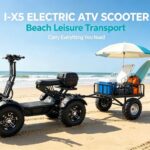
The EdgeMoto I-X5 offers standing and seated riding modes, with adjustable pole height and removable seat options . Standing provides maximum control and visibility for technical terrain, while seated operation reduces fatigue during long-distance cruising or utility work. This adaptability extends the vehicle’s utility from extreme sports to practical applications.
Utility Applications
Beyond recreation, electric ATV scooters excel in:
- Agriculture and property management: Silent operation doesn’t spook livestock; zero emissions allow indoor barn use
- Hunting and fishing: Stealthy approach to blinds and fishing holes without scent contamination from exhaust
- Camping and overlanding: Compact size fits in truck beds or RVs; sufficient power to haul gear trailers
EdgeMoto explicitly markets the I-X5 for these applications, offering trailer attachments and front/rear tool frame baskets as accessories . When comparing models, investigate available attachments—cargo racks, gun boots, and storage boxes transform recreational toys into productive tools.
7. Smart Features and Support Ecosystem: The Ownership Experience
Modern electric vehicles are as much about electronics as mechanics. Intelligent systems enhance safety, customization, and long-term satisfaction.
Controller Technology
The I-X5 employs an intelligent dual-control controller managing power delivery to all four motors . Advanced controllers offer:
- Variable speed modes: Beginner-friendly speed limiting with unrestricted access as skills develop
- Traction control: Prevents wheel spin on loose surfaces
- Diagnostic monitoring: Error code display for troubleshooting
The inclusion of Drive, Reverse, and Parking gears with automatic transmission simplifies operation for novices while providing the control needed for technical maneuvering .
Display and Connectivity
A high-definition intelligent LCD instrument panel with waterproofing provides essential information: speed, battery state-of-charge, trip distance, and error warnings . While Bluetooth connectivity and smartphone apps are increasingly common, prioritize reliability over gimmicks—a clear, bright display readable in direct sunlight is more valuable than social media integration.
After-Sales Support
Electric vehicles require specialized service that local mechanics may not provide. EdgeMoto addresses this by offering technical support, original parts supply, and comprehensive warranty coverage . Before purchasing any brand, verify:
- Warranty duration (2 years on batteries is competitive)
- Parts availability for wear items (tires, brake pads, bearings)
- Technical documentation and customer service responsiveness
Conclusion: Making Your Investment Count
The electric ATV scooter market ranges from underpowered toys to professional-grade machines capable of replacing gas-powered alternatives. By prioritizing these seven factors—motor configuration, battery capacity, suspension quality, braking performance, build durability, versatility, and smart support—beginners can navigate marketing hype to find vehicles delivering genuine value.
The EdgeMoto I-X5 exemplifies what happens when these factors are executed thoughtfully: quad-motor 4WD power, configurable high-capacity batteries, adjustable independent suspension, robust brakes, and a support ecosystem enabling years of reliable service . While its specifications may exceed entry-level budgets, understanding why these features matter allows informed comparisons across price points.
Remember that the “best” electric ATV scooter is the one that matches your specific terrain, usage patterns, and skill development trajectory. Start with honest assessment of where you’ll ride 80% of the time, then select capabilities that won’t limit growth as confidence builds. The silent revolution in off-road recreation awaits—choose wisely, ride safely, and embrace the electric future.
Ready to explore the EdgeMoto I-X5 and their full range of electric off-road vehicles? Visit www.edgemoto.com for detailed specifications, pricing, and customization options.