Electric motorcycles are having a moment in Europe. Sales of off-road models are surging, new street-legal machines are hitting showrooms every season, and riders across the continent are discovering the instant torque, whisper-quiet operation, and low maintenance that only an electric drivetrain can deliver. Whether you dream of carving mountain trails on a lightweight enduro or commuting through city streets on a sleek road machine, there has never been a better time to go electric.
But here’s the catch: the same model name can describe two completely different machines depending on whether it carries European street-legal certification or is sold as an off-road-only vehicle. Choosing the wrong one can mean anything from wasted money to legal trouble. Understanding the differences—before you buy—is the single most important decision an adult electric motorcycle buyer in Europe can make.
This guide breaks down exactly what separates a street-legal electric motorcycle from an off-road one: the regulations, the hardware, the licensing, the costs, and the real-world riding experience. No jargon overload. Just the facts you need to ride smart and ride legal.
The Regulatory Divide: What “Street-Legal” Actually Means in Europe
When a European dealer says a motorcycle is “street-legal,” they mean it has passed EEC type approval—a government-level homologation process that confirms the vehicle meets European Union safety, environmental, and technical standards. Without this approval, an electric motorcycle cannot be registered for road use in most European countries. It can’t get a license plate. It can’t be insured for public roads. It’s an off-road vehicle, full stop.
EEC approval isn’t a sticker or a self-declaration. It’s a formal type-approval process conducted by a member state’s transport authority and designated technical services. The manufacturer must submit the vehicle for testing, compile reports, and obtain an E-mark certificate before the model can be sold as road-legal anywhere in the EU. This is fundamentally different from CE marking, which covers only limited product categories and cannot substitute for vehicle type approval.
The regulatory framework is built on EU Regulation No. 168/2013, which classifies all L-category vehicles—mopeds, motorcycles, and quadricycles—according to their speed, power, and design characteristics. For electric motorcycles, two categories matter most:
L1e (Electric Moped): Maximum design speed of 45 km/h and maximum continuous rated power of 4,000 W (4 kW). These are the entry-level street-legal machines—light, affordable, and accessible to younger riders. A subcategory called L1e-B covers two-wheel mopeds that don’t fit the pedal-assisted L1e-A classification.
L3e (Electric Motorcycle): Everything above 45 km/h. This category covers a wide spectrum, from the L3e-A1 (limited to 11 kW continuous power and a power-to-weight ratio of 0.1 kW/kg) to the L3e-A2 (up to 35 kW) and beyond. L3e-A1 models have become especially popular for urban commuting because they balance real-world performance with accessible licensing requirements.
An important detail that surprises many riders: European regulators measure electric motor output using continuous rated power—the power the battery can sustain for 30 minutes—not peak power. A motorcycle might briefly deliver 20 kW of peak power but be homologated as an 11 kW machine because that’s what it can sustain. This is why some electric motorcycles feel dramatically faster than their official power rating suggests, and it’s a key reason the category exists as a practical bridge between mopeds and full motorcycles.
Off-road electric motorcycles, by contrast, sit entirely outside this framework. They don’t need EEC homologation because they’re not intended for public roads. They don’t carry license plates, and they’re banned from roadways, sidewalks, and any public surface where registered vehicles operate. Some off-road models can be converted to street-legal status if the manufacturer offers a homologated version, but doing so requires meeting every requirement of the L1e or L3e category—lights, mirrors, turn signals, brake performance, noise limits, and electromagnetic compatibility testing.
One of the most rigorous requirements for street-legal electric motorcycles in Europe is UN ECE Regulation No. 136 (R136) , which governs the safety of rechargeable energy storage systems. Every homologated electric vehicle must pass a battery of tests covering vibration, thermal shock, mechanical shock, fire resistance, overcharge protection, over-discharge protection, and over-temperature protection. A newer overcurrent test, mandatory since September 2025, requires the battery management system to trigger protective measures within milliseconds of an abnormal current surge. Manufacturers must also demonstrate insulation resistance of at least 500 Ω/V and verify that electromagnetic interference stays below 30 dBμV/m across a wide frequency range.
This level of testing is why street-legal electric motorcycles cost more than their off-road counterparts. The homologation process itself—from application through lab testing to certificate issuance—takes months and requires significant investment. Off-road models skip all of it, which keeps their price down but limits where you can legally ride them.
Hardware Differences: What Changes Between Road and Trail
The regulatory gap translates directly into hardware differences that you can see and feel the moment you throw a leg over the bike.
Lighting and visibility. Street-legal electric motorcycles come equipped with everything required for public roads: headlights with proper beam patterns, brake lights, turn signals, mirrors, a license plate holder, and reflectors. These aren’t optional accessories—they’re homologation requirements. Off-road versions strip all of it to save weight and avoid damage during trail riding. A recent example is the LiveWire S4 Honcho, which comes in two distinct versions: a street model with full road equipment and a trail version with knobby tires, a high front fender, and none of the street-legal hardware.
Tires and suspension. Street-legal machines typically run tires designed for a balance of grip, longevity, and low rolling resistance on pavement. Suspension is tuned for a mix of road comfort and occasional light off-road use. Off-road electric motorcycles go the other way: aggressive knobby tires for maximum traction in dirt, sand, and mud; long-travel suspension with 250–290 mm of travel to absorb roots, rocks, and jumps; and a frame geometry built for standing attack position rather than seated cruising. An off-road machine’s suspension would feel overly soft and wallowy on tarmac, while a street bike’s suspension would bottom out violently on a motocross track.
Battery and range. Street-legal electric motorcycles generally carry larger battery packs because range matters for commuting and touring. A road-focused machine might deliver 100–200+ km of range on a full charge. Off-road models often prioritize lightweight agility over maximum range, with 50–75 km being common—enough for a hard trail session, but not for a cross-country adventure. The trade-off is intentional: less battery weight means better handling in technical terrain.
Power delivery. This is where things get interesting. Off-road electric motorcycles often have more aggressive throttle mapping and higher peak power because they don’t need to meet on-road noise, emissions, or continuous power regulations. A street-legal L1e model is capped at 45 km/h and 4 kW continuous, but an off-road version of the same platform might deliver 10 kW or more and hit 80 km/h on a dirt track. The speed limiter is often the only physical difference—electronics, not hardware, separate road compliance from off-road capability.
Weight and ergonomics. Street-legal models carry the weight of lights, mirrors, turn signals, a larger battery, and sometimes a more substantial frame. They also tend to have more comfortable seating positions for longer rides. Off-road machines are lighter, more compact, and designed for active body movement—standing, shifting weight, and absorbing impacts with your knees and elbows.
Licensing and Registration: What You Need to Ride
The licensing requirements differ as dramatically as the hardware.
For street-legal electric motorcycles in the L1e category, riders in most EU member states need an AM-category license (available from age 14 in many countries) or a standard car license (category B) that includes moped entitlement. Registration, insurance, and technical compliance are all mandatory. The vehicle must carry a license plate, and the rider must be insured for liability.
For L3e-A1 models, the requirements step up: an A1 motorcycle license (from age 16 in most countries) or a car license held for three or more years. Some countries, like France and Germany, offer a practical bridge for car license holders through a short training course. In 2026, new B-license holders in some jurisdictions must complete a mandatory seven-hour course before riding an 11 kW motorcycle, while those who held a B license for three or more years before January 1, 2026 retain the older automatic entitlement.
For off-road electric motorcycles, licensing works differently. On private property, no license is required at all—you can ride whatever you want, wherever the landowner permits. But the moment you leave private land, you’re on thin ice. Off-road vehicles are banned from public roads, sidewalks, and most public trails in most European countries. Some jurisdictions allow off-road vehicles on designated trail systems or in OHV parks, but these are the exception, not the rule. And converting an off-road bike to street-legal status after purchase is rarely straightforward—it requires the manufacturer to have a homologated version of the exact model, and even then, the paperwork can be substantial.
Riding Experience: Two Very Different Worlds
The regulatory and hardware differences shape two completely different riding experiences.
A street-legal electric motorcycle is your daily companion. It’s quiet enough to ride through residential neighborhoods without drawing complaints. It’s cheap to charge—a full battery might cost a few euros at residential electricity rates. It needs minimal maintenance: no oil changes, no spark plugs, no air filters, no exhaust system. Routine care involves checking brake fluid levels, inspecting chain tension weekly, and servicing the suspension annually or every 50 hours of riding. For commuters, it’s a genuinely practical alternative to a car or public transit, with the added bonus of instant torque that makes city traffic almost fun.
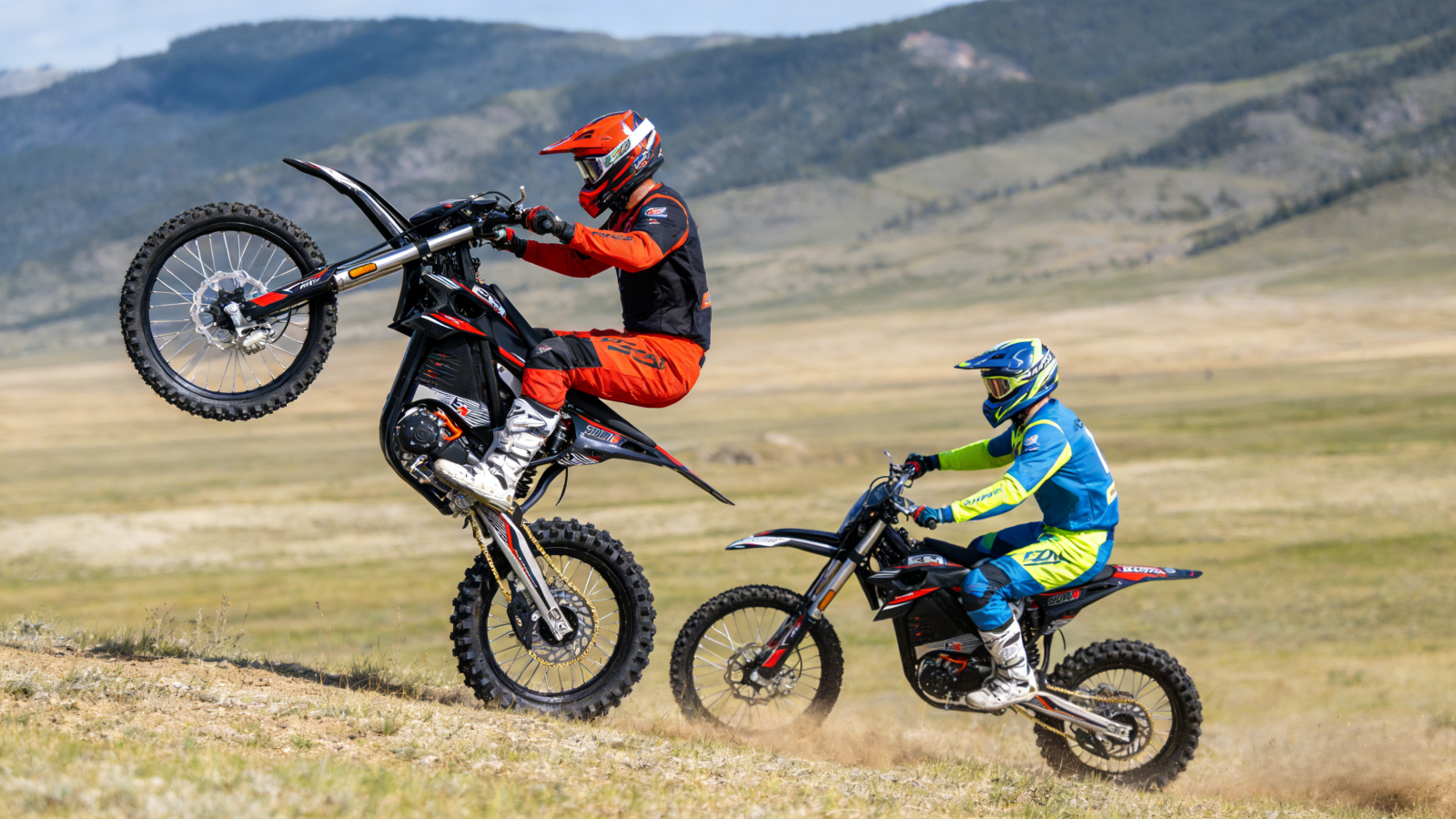
An off-road electric motorcycle is a weekend weapon. It’s built for trails, motocross tracks, and technical terrain where pavement never touches the knobby tires. The riding position is aggressive and active—you’re standing, shifting weight, and working the bike with your whole body. The power delivery is instant and often violent in the best possible way. And the silence of the electric motor transforms the off-road experience: you hear the tires biting into dirt, the suspension working, your own breathing. It’s a more intimate, more focused kind of riding.
But the off-road experience comes with logistical challenges. You need a truck or trailer to get the bike to the trail. You need to find legal places to ride—which, in many parts of Europe, is harder than it sounds. And you need to accept that the bike is useless for transportation. It’s a toy, a very capable and thrilling toy, but a toy nonetheless.
Cost and Ownership: Where the Money Goes
The price gap between street-legal and off-road electric motorcycles is real but not always as large as the regulatory burden might suggest.
Off-road electric motorcycles often start around €4,500–€5,000 for entry-level models with 8–12 kW of power. Street-legal L1e versions of similar platforms typically cost €1,000–€2,000 more due to homologation costs, lighting equipment, and sometimes larger batteries. For example, one popular model is sold off-road at €4,990 or as a street-legal L1e version at €5,690—a €700 premium for road legality. Higher-performance L3e models can run €6,500–€13,000 or more, depending on power, battery capacity, and brand.
On the ownership side, street-legal electric motorcycles carry ongoing costs that off-road bikes avoid: registration fees, mandatory liability insurance, and periodic technical inspections. Recent EU proposals could extend mandatory roadworthiness testing to all motorcycles over 50 cc, including electric models, which would add inspection costs to the street-legal ownership equation. Off-road bikes on private property sidestep all of this.
Maintenance costs, however, are low for both. Electric drivetrains eliminate the most expensive and frequent service items—oil changes, valve adjustments, clutch replacements—and the remaining maintenance (brakes, tires, chain, suspension) is straightforward and infrequent. Over five years, an electric motorcycle’s total cost of ownership can be significantly lower than a comparable gas-powered machine, even before factoring in fuel savings.
How to Choose: A Practical Decision Framework
So which one is right for you? Start with how you’ll actually ride.
Choose a street-legal electric motorcycle if:
- You want to commute, run errands, or replace car trips with two-wheeled transport
- You need to ride on public roads legally, with registration and insurance
- You value convenience over maximum off-road performance
- You’re comfortable with licensing requirements (AM, A1, or B-license entitlement)
- You want a vehicle that’s ready to ride the moment you step outside
Choose an off-road electric motorcycle if:
- You have access to private land, a trail system, or an OHV park
- Your priority is maximum performance, lightweight agility, and technical terrain capability
- You’re willing to transport the bike to riding locations
- You don’t need—and won’t miss—street-legal equipment
- You want the lightest, most focused machine for pure off-road riding
Consider a convertible model if:
- You want the option to ride both on and off-road legally
- Some enduro-oriented electric motorcycles carry L3e road certification while still being capable off-road, allowing legal transit between trail sections
- Be aware that switching to off-road mode (often called “derestriction”) removes street legality—the bike must remain in its homologated configuration to be road-legal
One final piece of advice: verify the homologation documents before you buy, especially if you’re importing from outside the EU. In 2024, only 99 out of 217 imported electric vehicles assessed by one European transport authority passed compliance checks. Forged or incorrect type-approval certificates are a real problem, and buyers who end up with a non-compliant vehicle may face customs detention, financial loss, and no legal way to ride their purchase.
Final Thoughts
Europe’s electric motorcycle market is maturing fast, and the choice between street-legal and off-road models has never been clearer—or more important. Street-legal machines give you freedom: the freedom to ride anywhere, anytime, with the full backing of European law. Off-road machines give you purity: no lights, no mirrors, no compromises, just you, the bike, and the terrain.
Both are excellent. Both are thrilling. And both represent a future where electric power makes motorcycling quieter, cleaner, and more accessible than ever before.
The key is to choose with your eyes open. Understand the regulations, respect the licensing requirements, and pick the machine that matches your actual riding life—not the fantasy version of it. Do that, and you’ll end up with a bike you ride every chance you get, grinning inside your helmet every single time.
Happy riding.